 Nisha Salsabilla
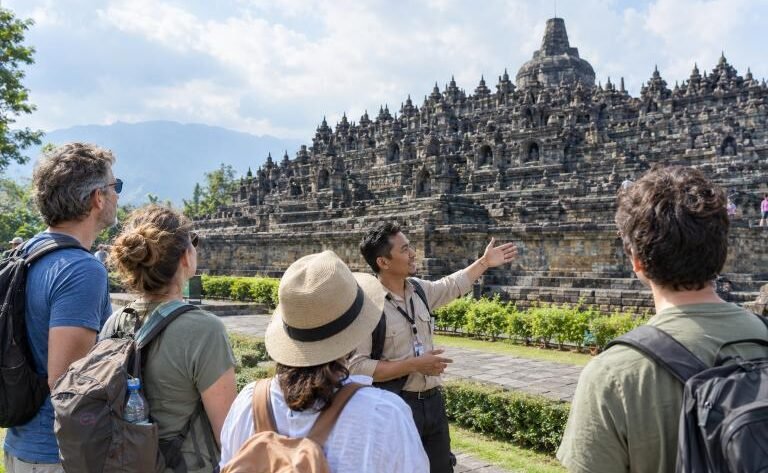
A Borobudur Historical Tour offers a way to explore the monument through its construction, changing significance, and preservation. Instead of viewing the structure only as an impressive landmark, follow its story across different periods. This approach connects what you see today with the people who built, studied, and restored it.
Organize the visit around a few historical questions: When was Borobudur built? What ideas shaped its design? How did it survive, and why does its conservation remain important?
Borobudur Historical Tour: Begin with Construction
Borobudur was built in Central Java during the eighth and ninth centuries under the Syailendra Dynasty. UNESCO identifies it as one of the world’s greatest Buddhist monuments and an exceptional achievement of that period.
Begin your tour with this context before examining individual features. Ask your guide to explain what is known about the building period and where historical interpretation remains uncertain.
Avoid reducing the monument’s creation to a single date. Its historical importance comes from the wider artistic and religious setting in which it developed.
Understand the Monument’s Design
The structure’s arrangement reflects Buddhist ideas rather than decoration alone. UNESCO describes Borobudur’s three main levels as representing stages within Buddhist cosmology: the world of desires, the world of forms, and the formless world.
Ask your guide to connect these concepts with the architecture visible during your permitted visit. This helps explain why the monument’s layout matters.
Reliefs and sculptural details also deserve attention. Choose a few examples and explore how they contribute to the larger religious meaning of the structure.
Explore Rediscovery and Historical Study
UNESCO’s historical account identifies 1814 as the year Borobudur was brought to renewed attention under British administration. However, describing this as “rediscovery” should not imply that the monument had never been known to local people.
Use this stage of the tour to ask how documentation and research changed public understanding of the site.
Keep established evidence separate from dramatic stories about its earlier decline. Where explanations are uncertain, acknowledge that uncertainty rather than presenting one theory as settled history.
Learn about the Restoration Effort
A major international restoration coordinated by UNESCO took place from 1973 to 1983. The project brought together Indonesian and international efforts to safeguard the monument.
Include conservation in your Borobudur Historical Tour, not merely as an ending but as part of the monument’s continuing history.
Ask what restoration means for the structure visitors see today. Understanding the work involved helps explain why access rules and careful visitor management matter.
Understand Its World Heritage Significance
Borobudur was inscribed on the UNESCO World Heritage List in 1991. Its recognition reflects the importance of its architecture, artistic achievement, and Buddhist cultural meaning.
Consider how these qualities connect: its historical significance cannot be separated entirely from its religious ideas or visual design.
Plan a History-Focused Visit
Choose a Borobudur Historical Tour that allows time for explanations and questions. Ask whether the guide will cover construction, symbolism, historical research, and restoration.
A clear chronological approach makes these subjects easier to follow and helps turn separate facts into a connected understanding of the monument’s past.